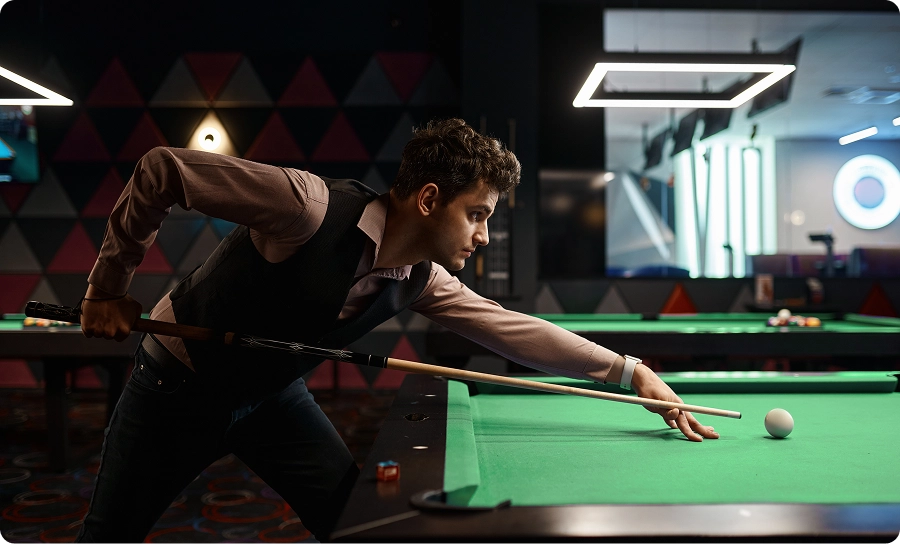
Most new players improve faster when they stop chasing difficult shots and start repeating the same core fundamentals every time they step to the table. Good pool is built on balance, timing, and cue-ball control long before it is built on flash.
That is why the best pool tips for beginners are the ones that make the game feel simpler. A repeatable stance, a smoother stroke, and smarter decisions will usually help you win more racks than trying to force low-percentage shots too early.
At Texas Billiards Club, we see beginners improve the fastest when they focus on habits they can practice every visit. A few reliable skills can change the entire pace of your learning curve.
Strong fundamentals give beginners a way to trust their stroke, control the cue ball, and keep improving without overcomplicating the game.
Build a stance and stroke you can repeat
A beginner does not need a perfect textbook stance, but it does need to feel stable and repeatable. Start by planting your feet in a position that lets you stay balanced through the shot instead of drifting or standing up early.
Your stroke should feel smooth rather than forced. Keep your grip relaxed, let your cue travel in a straight line, and finish the shot with a calm follow-through so your body is not fighting the motion.
- Keep your head still as you deliver the cue.
- Set your bridge hand early so the cue has a clear path.
- Use a relaxed grip instead of squeezing the butt of the cue.
- Pause briefly before the final stroke to settle your aim.
- Stay down after contact long enough to see the result of the shot.
Learn cue-ball control before power
Beginners often think the goal is only to pocket the current ball, but the real key to winning more often is leaving the cue ball in a useful place for the next shot. Even basic speed control will make the game feel easier.
You do not need advanced spin to get better. Start with stop shots, simple follow shots, and short draw shots. Those patterns teach you how the cue ball reacts and help you plan one shot ahead instead of starting over every turn.
- Practice stop shots from short distance until the cue ball stays near the contact point.
- Hit follow shots softly to learn how speed changes cue-ball travel.
- Use simple routes instead of trying to move the cue ball across the whole table.
- Think about the next shot before you get down on the current one.
Common pool mistakes beginners should avoid
A lot of early frustration comes from a few repeated mistakes rather than a lack of talent. Cleaning up those habits can create progress faster than learning a brand-new technique.
- Rushing into the shot before your feet and bridge are set.
- Trying difficult cut shots when a simpler safety or easier ball is available.
- Standing up too soon and pulling the cue off line.
- Hitting every shot too hard instead of matching speed to position.
- Ignoring cue-ball position and celebrating a made ball that leaves no next shot.
What is a simple practice routine for new players?
A short and focused routine usually works better than a long session with no clear goal. Give yourself one skill to work on at a time so every rack has a purpose.
Even thirty minutes of structured practice can build confidence if you repeat it consistently. The point is not to do everything in one day. It is to build a foundation that keeps paying off every time you come back to the table.
- Spend the first ten minutes on straight-in shots with a steady pre-shot routine.
- Spend ten minutes on stop, follow, and draw from short distance.
- Play a few simple position drills using two or three balls only.
- Finish with one short rack where your goal is cue-ball control, not power.
- Write down one mistake and one improvement point before your next visit.